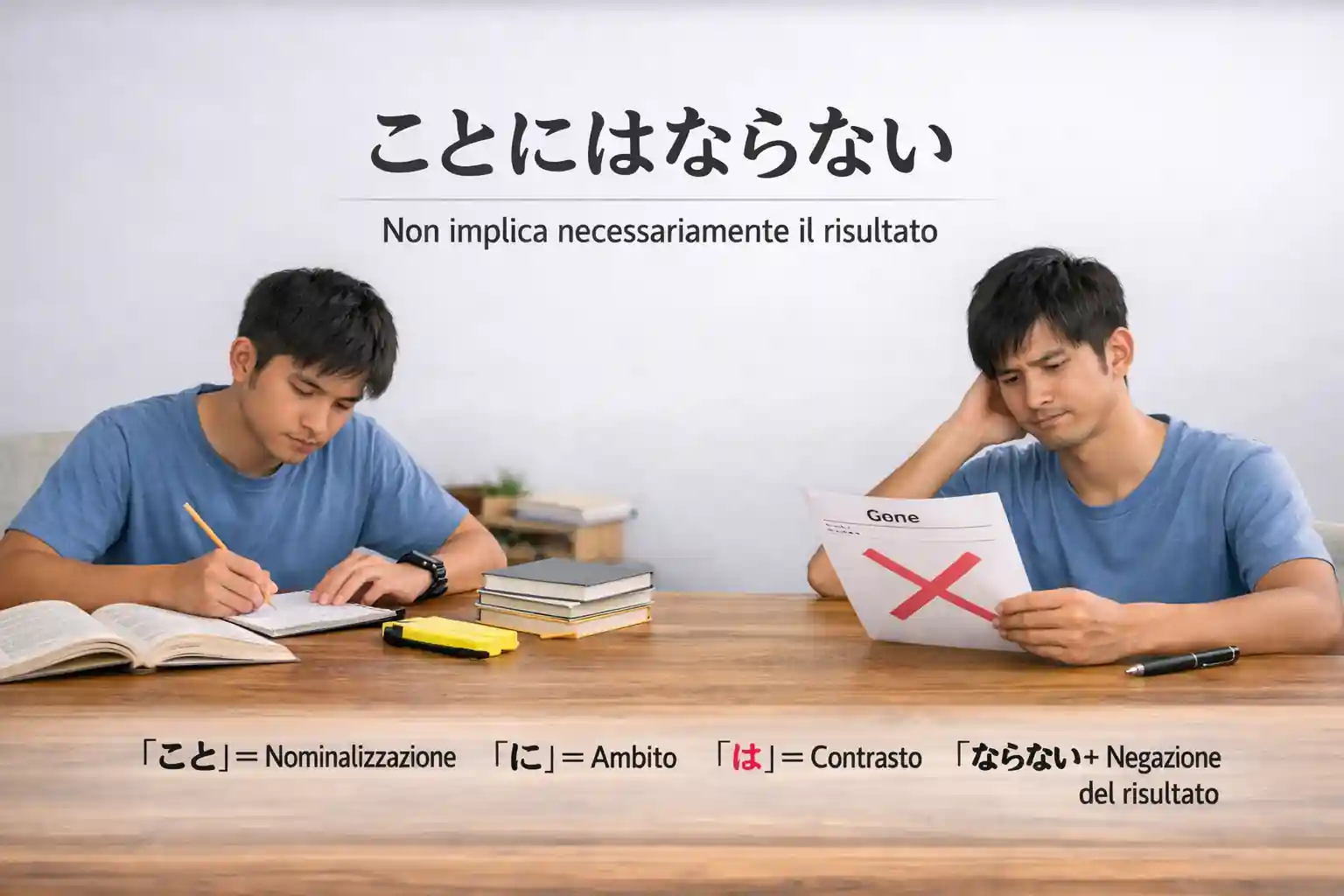
に越したことはない (ni koshita koto wa nai): Meaning, Usage, and Grammar
Why it means “there’s nothing better than...”: structure, nuance, and real usage
Category: Grammar Dissections
What does に越したことはない mean in Japanese? And why is this structure so often translated as “there’s nothing better than…”?
The general meaning of に越したことはない (ni koshita koto wa nai) is: “there’s nothing better than…”, “the best thing is…”, “it is preferable to…”, or, in many natural sentences, “if possible, it’s better to…”.
It is not, however, a blunt piece of advice like “you have to do it this way”. It is a very common construction used when the speaker evaluates something as the ideal or preferable choice, often with a practical nuance of caution: “better safe than sorry”, “that would be the preferable option”.
For this reason, it often appears in advice, recommendations, and sentences involving preparation, safety, or the realistic management of situations.
に越したことはない therefore presents something as the most desirable, prudent, or advantageous solution among the available options.
Its range of use is therefore connected to advice and recommendations with a moderate tone: “better to prepare”, “better to be cautious”, “better to have time”, “better to avoid problems”, “better not to be caught unprepared”, “it isn’t mandatory, but if possible, it’s the best solution”.
The structure comes from the verb 越す(こす, kosu), which means “to surpass”, “to go beyond”, “to be superior to”. Literally, X に越したことはない conveys the idea that “there is no thing that surpasses X”, that is, that nothing is better than X.
This is where the modern idiomatic value comes from: X is not always mandatory, nor is it necessarily the only possible choice, but it is the safest, most reasonable, or most convenient choice.
At first glance, it may look like a difficult formula to break down: why does 越す appear here? Why is the form 越した? What role does ことはない play? And above all, how close is it really to expressions such as ほうがいい, べきだ, or に限る?
The answer is that に越したことはない should not be learned by rote. A non-native speaker, in order not to forget it, needs to understand and absorb it. It is a structure that evaluates X as something that no alternative truly surpasses.
In this article, we will therefore look at the meaning of に越したことはない, its grammatical structure, the role of 越す and ことはない, the reason why it expresses the idea of “there’s nothing better”, the contexts in which it is most often used, and the main differences from other expressions of advice, preference, or necessity.
Meaning and Use of に越したことはない: the best choice, not an obligation
General meaning
The construction X に越したことはない expresses the idea that X is the best, safest, or most desirable choice among the possibilities being considered.
In English, it can be rendered with formulas such as “there’s nothing better than X”, “the best thing is X”, “X is preferable”, or, more naturally depending on the context, “if possible, X is better”.
The key point is that に越したことはない does not function as an order. It does not mean “you have to do X” and it does not fully coincide with a rigid prescription. Rather, the speaker presents X as the ideal, reasonable, or prudent solution: something it would be better to choose, have, or do, if conditions allow.
For this reason, the structure often carries a nuance of non-binding recommendation. It says that X is preferable, but leaves open the possibility that X may not always be feasible, necessary, or available. In other words, it frames X as close to the ideal, without automatically turning it into an obligation.
Most common contexts of use
に越したことはない often appears in sentences related to caution, preparation, and the realistic management of situations. It is very natural when talking about safety, health, money, time, prevention, planning, or risk.
For example, it is frequent with expressions that indicate precaution, such as 用心する, 確認する, 準備する, or with preventive actions such as making a backup, checking in advance, arriving early, avoiding a problem, or preparing for something unexpected.
The structure is also very common with scalar qualities oriented toward a desirable value: 早い (“early”), 安い (“cheap”), 近い (“near”), 多い (“many / much”), 少ない (“few / little”), 安全 (“safe”), 便利 (“convenient”).
In cases of this kind, the sense is often: “the more it has that quality, the better”, or “if it can be that way, all the better”.
For this reason, に越したことはない works well in sentences such as “it’s better to arrive early”, “it’s better for the price to be low”, “it’s better to have more time”, “it’s better to be cautious”, “it’s better not to have problems”.
It does not express absolute enthusiasm, but a practical evaluation: among the possible options, X is the one that offers the greatest advantages or the fewest risks.
An ideal choice, but not always realistic
An important characteristic of に越したことはない is that the choice presented as ideal can immediately be limited by the context. For this reason, the construction often appears together with が, けど, とはいえ, or other forms that introduce a restriction.
The mechanism is simple: the speaker recognizes that X would be the best solution, but also knows that reality may impose constraints.
For example: “it would be better to have more time, but we can’t postpone it”, “it would be better to choose the safest option, but it costs too much”, “it would be better to prepare in advance, but that isn’t always possible”.
This is one of the reasons why に越したことはない is different from more direct structures such as べきだ. While べきだ tends to express duty, moral necessity, or a strong recommendation, に越したことはない more often moves within the field of the practical ideal: it does not impose X, but presents it as the solution that would be preferable to choose.
Structure and idiomatic value
From a formal point of view, に越したことはない is a partly transparent structure. The verb 越す means “to surpass”, “to go beyond”, “to be superior to”. If the expression is broken down literally, X に越したことはない means something like “there is no thing that surpasses X”.
This is where the idiomatic meaning comes from: “nothing is better than X”.
At the same time, the construction should not be interpreted word by word as an ordinary sentence. The form 越した is formally a past attributive form, but within に越したことはない it does not express a true temporal past. It is a form that has become fixed within the construction.
For this reason, に越したことはない is a particular structure: it preserves a fairly clear semantic logic, because the idea of “surpassing” explains the value of “there’s nothing better” very well; but it also functions as a stabilized formula, to be recognized and absorbed as an autonomous grammatical unit.
In short, に越したことはない serves to present X as the best, safest, or most reasonable solution, without necessarily turning it into an obligation. It is precisely this combination of ideal, caution, and pragmatic realism that makes it different from many other Japanese expressions of advice or preference.
Formation and Grammatical Structure of に越したことはない
The basic pattern of the construction is:
X + に + 越した + こと + は + ない
where X represents the element evaluated as better, preferable, or safer. In other words, the sentence does not simply say that X is good, but that there is nothing that surpasses X: hence the idiomatic value of “there’s nothing better than X”.
From a grammatical point of view, X can be formed in several ways:
-
Verb in plain form:
準備しておくに越したことはない “There’s nothing better than preparing in advance / it’s better to prepare.” -
Verb in non-past negative form:
無理をしないに越したことはない “It’s better not to overdo it.” -
い-adjectives:
早いに越したことはない
“The earlier, the better / it’s better for it to be early.” -
な-adjectives:
安全に越したことはない
“It’s better for it to be safe / safety is best.” -
Noun:
経験者に越したことはない
“It’s better for it to be someone with experience.”
With な-adjectives and nouns, grammar descriptions often also show the form with である:
-
安全であるに越したことはない
“It’s better for it to be safe.” -
経験者であるに越したことはない
“It’s better for it to be someone with experience.”
This form is more explicit and slightly more formal, because it makes the underlying predicative structure visible: “to be X”. In real language, however, especially with short and common words, more compact forms such as 安全に越したことはない, 便利に越したことはない, 経験者に越したことはない are also often found.
An important practical point is that に越したことはない typically attaches to non-past forms: dictionary form, non-past negative form, adjectives, and nouns used as general properties.
This is consistent with the meaning of the construction: the speaker is not saying that something “was better” in the past, but is evaluating X as a preferable solution in general or in a given situation.
For this reason, the form 越した should not be interpreted as a true past tense. Formally, it is a past attributive form of the verb 越す, but within に越したことはない it has become fixed in the construction and serves to form the overall idiomatic meaning: “there is no thing that surpasses X”, therefore “nothing is better than X”.
Dissection
Before analyzing the individual elements of the construction, it is useful to note that に越したことはない (as we will also see later) is not a completely opaque expression. Its modern meaning, in fact, arises from the combination of parts that are still recognizable: に, 越した, and ことはない.
The difficulty lies not so much in translating each element in isolation, but in understanding how these elements combine to produce a single overall meaning: “there is nothing that surpasses X”, and therefore “there is nothing better than X”.
This is precisely why grammatical dissection is especially useful: it allows us to see how a seemingly idiomatic structure still preserves a fairly clear internal logic.
The particle に
In this construction, に should not be read as a simple marker of place or time, but as an indicator of the standard against which surpassing is measured.
This function emerges naturally from the semantics of 越す (“to surpass”, “to go beyond”), which requires a point of reference. The particle に therefore marks the element in relation to which something is judged superior.
A similar use can also be observed with other verbs that introduce a comparison (for example 勝る), although with different nuances: while verbs such as 似る express a relation of similarity, 越す implies a hierarchy and a surpassing.
In other words, X に 越す can be understood as “to go beyond X / to surpass X”, where X functions as the standard of comparison, and the entire construction preserves this comparative orientation even in the idiomatic form に越したことはない.
越す → 越した (to surpass, to go beyond)
越す (こす) is a verb that preserves its fundamental meaning of “to surpass” or “to go beyond”.
However, in the construction に越したことはない, this lexical value is incorporated into a sequence that shows features of idiomatic fixedness. It is therefore not an idiomatic use of the verb itself, but a construction as a whole which, while remaining partly transparent, functions as a semi-grammaticalized unit.
The form 越した is the -た form (past) in attributive use before a noun: here it modifies こと (“the ‘thing/case’ of having surpassed…”).
In the construction, however, this past should be understood as part of the fixedness of the expression: it does not necessarily convey a past temporality of the event X, but contributes to the reading of “completed/possible surpassing”, from which “there is nothing beyond it” follows.
ことはない (final negation that conveys the idea of “there is nothing better”)
The locution ことはない deserves a separate discussion, because it constitutes a well-defined construct in Japanese grammar, with its own meaning.
It mainly serves to deny the necessity or advisability of performing an action. It is made up of a verbal form + こと (nominalizer) + the particle は + the negative form ない, and takes on the meaning of “it is not necessary to do X”, “there is no need to”, or “it is impossible that X”.
It is often used to advise or reassure someone.
The particle は emphasizes the topic, introducing a domain with respect to which something is denied (“as for X, there is no necessity / reason”).
Sentences such as に越したことはない (“nothing is better than…”) build precisely on this pattern: ~に越した is constructed from 越す (“to surpass”), in its past attributive form 越した, which modifies こと.
From a morphological and syntactic point of view, こと functions as the nominalizer of the entire predicate (in this case 越した), は marks the topic, and ない negates the existence or necessity of the action. The result is not a simple negation, but an evaluation: it states that there is nothing that surpasses X.
Recomposition: why に越したことはない means “there’s nothing better”
After breaking に越したことはない down into its individual elements, we can put the full structure back together.
The internal logic of the expression is as follows:
- X + に indicates the reference point against which the idea of “surpassing” is evaluated;
- 越した comes from 越す, “to surpass”, “to go beyond”, “to be superior to”;
- ことはない closes the structure with the sense of “there is no thing / there is nothing”.
Literally, then, X に越したことはない sounds like:
“There is no thing that surpasses X.”
From this reading comes the natural meaning of the construction:
- “there’s nothing better than X”
- “the best thing is X”
- “if possible, X is better”
- “X is the preferable solution”
For example:
健康に越したことはない - “There’s nothing better than health.”
Literally: “there is nothing that surpasses health.”
The important point (as we have already emphasized) is that the structure does not simply say that X is positive. It says that, among the possibilities being considered, X is what no alternative truly surpasses.
For this reason, に越したことはない is not a rigid obligation, but an “assessment of preferability”: X is presented as the best, most prudent, or safest choice, often with the implicit sense of “if conditions allow”.
This nuance is consistent with explanations that describe the construction as “better to X if possible” or as the ideal choice.
Register and Politeness Variants
に越したことはない belongs to a neutral or mid-formal register. It is not archaic, literary, or solemn, but it does not sound especially colloquial either: it is natural in careful speech, in writing, in explanatory texts, in practical advice, and in professional contexts.
Precisely because it expresses a prudent and reasonable evaluation of the type “if possible, this is better”, “this is the safer choice”, “there’s nothing better”, it fits well in sentences of recommendation, prevention, or common sense.
For this reason, it can easily appear in contexts related to health, safety, work, study, preparation, money, or risk management.
The base form に越したことはない is perfectly natural in a neutral style:
準備しておくに越したことはない。
“It’s better to prepare in advance.”
When the sentence needs to be made more polite, especially in formal writing, explanatory texts, professional communication, or business contexts, に越したことはありません is often used:
事前に確認するに越したことはありません。
“It’s better to check in advance.”
The form に越したことはないが/けど is also very common, used when the speaker recognizes that X would be the ideal solution, but then immediately introduces a practical limitation:
早く始めるに越したことはないが、今すぐには難しい。
“It would be better to start early, but it’s difficult right now.”
This possibility is consistent with the pragmatic value of the construction: に越したことはない often indicates an ideal or preferable solution, but not necessarily something mandatory or always feasible.
Variants of style and politeness
-
に越したことはない
Standard neutral form. Natural in writing, careful speech, and general explanations. -
に越したことはありません
Polite form. Very suitable for formal texts, explanations, professional communication, and business contexts. -
に越したことはございません More formal and ceremonious variant. Possible in very polite contexts, but less necessary in common usage than に越したことはありません.
Overall Interpretation: transparency vs idiomaticity
At this point, an important question can be asked: is に越したことはない a transparent construction that can be understood from its individual elements, or is it an idiomatic expression to be learned as a single block?
The most precise answer is: both, but to different degrees. The structure is largely understandable if one knows its components: 越す means “to surpass”, こと nominalizes what precedes it, は marks the topic of the negation, and ない expresses non-existence. From this comes a fairly clear literal reading: “there is no thing that surpasses X”.
The shift from “there is nothing that surpasses X” to “X is the best” is a natural inference, widely attested in other languages as well (think of the English nothing beats X). Japanese lexicography itself makes this reading explicit through paraphrases such as 〜するのがいちばんよい, showing a stable compositional correspondence.
However, に越したことはない does not function as a completely free combination. In the modern language, it is a stabilized construction, recognized as a grammatical formula with a value of its own: it expresses that X is the best, safest, most reasonable, or most desirable choice among the possibilities being considered.
Why it is a semi-idiomatic construction
There are at least three clues that show its degree of “idiomatization”.
The first clue is that the form is fixed. The normal sequence is 越したことはない, with 越した in the past attributive form. This form, however, does not indicate a true past. It does not mean that something “surpassed” X in the past, but participates in the fixed formula that produces the overall meaning “there’s nothing better than X”.
Freely replacing it with other forms, such as 越すことはない, does not produce the same idiomatic value.
The second clue is the conventionalization of meaning. When a Japanese speaker hears a sentence such as 健康に越したことはない, they do not interpret it from scratch each time as “there is no thing that surpasses health”.
They recognize it directly as an evaluative formula: “health is the best thing”, “there’s nothing better than health”, “it’s better to be healthy”.
The third clue is its behavior as a complex expression. に越したことはない is made up of several words, but in practice it functions as a single grammatical unit: it attaches to verbs, adjectives, or nouns and adds to the sentence a modal value of preferability, prudence, or ideal choice.
For this reason, the construction can be defined as semi-idiomatic. Its meaning remains largely reconstructable from its elements, because the idea of “surpassing” explains the value of “there’s nothing better” very well.
At the same time, however, real usage follows a fixed and conventionalized pattern: X に越したことはない is not just any freely constructed sentence, but a recognizable grammatical formula with a precise function in the modern language.
In short, に越したことはない is not an opaque expression to be memorized without understanding it, but neither is it a simple mechanical sum of words.
The construction can therefore be defined as semi-idiomatic: its meaning remains largely reconstructable from its components, but its real usage follows relatively fixed and conventionalized patterns.
It is therefore a structure that is transparent in its logic, but idiomatic in its use: precisely for this reason, if one is not a native speaker, it is best to study it both through grammatical dissection and as an autonomous expressive unit.
Comparison with Structures of Similar Meaning
-
に限る: both constructions can express the idea that X is “the best thing”, but に限る tends to be more decisive, subjective, and assertive, often close to formulas such as “when it comes to X, nothing beats Y”. に越したことはない, by contrast, presents X as the preferable, safer, or more reasonable choice, but without the same exclusive force.
In other words, に限る sounds more like a firm conviction or a preference based on experience, whereas に越したことはない formulates a practical ideal: “if possible, this is better”.
-
ほうがいい: both constructions can convey advice, but に越したことはない expresses an idea of abstract optimality (“there’s nothing better”), while ほうがいい typically operates on a more concrete, decision-based level, tied to a choice between alternatives in context.
In other words, ほうがいい implies a practical comparison (“between A and B, A is better”), whereas に越したことはない does not necessarily presuppose an immediate choice, but formulates an ideal evaluation.
-
べきだ: tends to express a duty or obligation of a normative kind (logical, moral, or social), often perceived as more objective and binding. Compared with に越したことはない, which proposes a non-imposed preference, べきだ introduces stronger and less softened normative pressure, especially when directed at others.
-
ないほうがいい: represents negative advice, often based on the prediction of undesirable consequences (“it is better to avoid X”). It can therefore come close to a warning. In this sense, it differs from に越したことはない, which does not arise from an evaluation of risk, but from an orientation toward what is considered optimal.
-
V辞書形+ことはない: beware of the false parallel! Although it shares the formal sequence ことはない, this construction typically means “there is no need to…” or “it is not necessary to…”, with frequent uses of reassurance or criticism. In に越したことはない, by contrast, ことはない does not retain this modal value, but participates in a fixed locution with an evaluative meaning: “there is nothing that surpasses X”.
These differences will be taken up more fully in a dedicated comparison between に越したことはない, に限る, ほうがいい, and べきだ.
Usage Examples
傘を持っていくに越したことはない。 念のため、バックアップを取っておくに越したことはない。 早めに出発するに越したことはないよ。 健康診断は毎年受けるに越したことはない。 外国語は話せるに越したことはない。 渋滞はないに越したことはない。 ミスは少ないに越したことはありません。 直接会って話すに越したことはないが、今日はオンラインで進めよう。 トラブルは起きないに越したことはない。 資料は新しいに越したことはないです。
Conclusion
に越したことはない is a construction that, behind its idiomatic appearance, preserves a very clear internal logic. The verb 越す means “to surpass”, “to go beyond”, “to be superior to”; ことはない closes the structure with the idea of non-existence.
For this reason, X に越したことはない can be traced literally back to “there is nothing that surpasses X”, from which comes the natural meaning of “there’s nothing better than X”, “the best thing is X”, or “if possible, X is better”.
The central point is that this structure does not impose an obligation. When a speaker uses に越したことはない, they are not necessarily saying “you have to do it this way”, but presenting X as the most prudent, safest, most reasonable, or most desirable solution.
For this reason, the construction often appears in contexts related to prevention, preparation, safety, health, money, time, and the realistic management of risk.
From a grammatical point of view, it is a semi-idiomatic construction: the meaning can be reconstructed from its elements, but the form is now stabilized.
In particular, 越した does not express a true temporal past, but forms part of the fixed formula that produces the overall value of “nothing surpasses X”. For this reason, translating word by word is not enough: the structure must be recognized as an autonomous grammatical unit.
Its nuance also distinguishes it from related expressions. ほうがいい formulates more direct and concrete advice; べきだ introduces stronger normative pressure; に限る sounds more assertive and subjective, like a firm conviction of the type “nothing beats X”.
に越したことはない, by contrast, remains more attenuated: it indicates what would be ideal, preferable, or safer, without erasing the possibility that, in reality, constraints, alternatives, or compromises may exist.
In short, に越したことはない is a structure of prudent evaluation. It is used to say that a certain choice, condition, or action is the best among those being considered, but without necessarily turning it into a command.
Understanding it through its structure — X に + 越した + ことはない — therefore makes it possible to grasp not only its meaning, but also its most important nuance: the idea of a practical ideal, desirable, but not always mandatory or feasible.