~ところだった | Meaning, Correct Usage, and Grammatical Analysis
How to use ところだった correctly to express near misses, missed opportunities, and situations that almost happened
Category: Grammar Dissections
What does ところだった really mean in Japanese?
The pattern ところだった (tokoro datta) is used in Japanese when the speaker looks back on a situation and says that an event was about to happen, but ultimately did not happen, or that it came very close to happening but never actually occurred.
In teaching grammars, it is primarily introduced in the form V(dictionary form / negative form)+ ところだった, with meanings close to “I was about to…”, “almost…”, or “nearly…”.
It is very common in sentences such as 遅刻するところだった – “I almost arrived late”, 忘れるところだった – “I was about to forget”, and 事故になるところだった – “it was very close to turning into an accident.”
From a practical point of view, it is useful to keep two closely related interpretations in mind. The first is the almost “photographic” interpretation: I was right on the verge of doing X. The second is the interpretation more commonly encountered in everyday communication: X did not happen, but it came extremely close to happening.
For this reason, the structure often appears together with expressions such as もう少しで, あと少しで, and 危うく. It also very frequently describes a danger or negative outcome that was avoided, although in certain contexts it can also indicate that a positive outcome was just about to be achieved, often together with のに.
In the following sections, we will examine its general meaning, delve into the core mechanics of ところだった by breaking it down and analyzing how its components combine in order to appreciate its deeper meaning; we will see how idiomatic it is and how much of its meaning can be understood compositionally; we will examine its context and register, and finally conclude with the usual usage examples and summary.
ところだった: General meaning
The meaning of ~ところだった is roughly “I was just about to ~~” or “I was on the verge of ~~.” This construction describes a near-event: an action or event that was imminent but did not take place.
This form is used precisely to express situations that almost occurred or were “close” to being completed.
For example:
- 「電車に乗り遅れるところだった」- “I almost missed the train”.
That is, it came very close to happening (but in the end I managed to get on the train). In negative contexts, it can be used to say “a bad outcome almost happened”:
Example:
- 「危うく事故に遭うところだった」- “I almost had an accident”.
Conversely, it can also imply a positive result that was missed (“I almost made it, but it did not turn out that way”). In short, ~ところだった always signals that something was on the verge of happening (whether positive or negative), but then the outcome turned out differently.
Formation and grammatical structure
The construction ~ところだった is formed by placing the word ところ after the verb, followed by だった (the past form of だ). In practice:
- Verb (base form) + ところだった.
In many textbooks, the connection is described as “verb in plain form (or negative form) + ところだった.” For example: 買う → 買うところだった (“I was about to buy”). Sometimes the form with the verb in the negative (〜ない形) before ところだった is also found, to emphasize an action that did not occur. For example, 買わないところだった (“I almost forgot to buy it”).
In any case, the basic structure remains verb-base + ところだった.
In detail, ところ was originally the noun meaning “place” or “moment,” and in this construction it means the very moment just before the action.
The addition of だった, the past form of the copula だ, places the action in a past context.
The combination of 「ところ」 (moment/place) and 「だった」 emphasizes having been at the point/in the situation of carrying out the action. In practice, the structure can be analyzed as follows:
-
Verb (plain form): indicates the imminent action (e.g. 忘れる “to forget”);
-
ところ: literally “point” or “moment” of the action;
-
だった: past form of だ (“was”), indicating that the action was on the verge of occurring in the past.
In the following sections, we will analyze these elements in detail.
Grammatical dissection
The noun ところ
At its core, ところ / 所 means “place,” “location,” or “point.” However, in grammatical constructions this concrete meaning becomes much lighter: it turns into a formal noun, that is, a word which says very little on its own and derives most of its meaning from what precedes it.
Lexicographical and pedagogical descriptions show that, in various constructions, ところ can move from a spatial meaning to a value of position in time, and then to the more abstract notion of a situation.
For this reason, in expressions such as 行くところ, the meaning is often not “the place of going,” but rather “the point / stage / situation in which one is about to go.” Precisely because it functions here as a formal noun, it is normally written in hiragana rather than kanji.
The verbal form that precedes ところ is equally important. Within the ところだ system, Japanese grammar distinguishes three points in the process:
- Vる + ところだ for the moment immediately before the action;
- Vている + ところだ for an action in progress;
- Vた + ところだ for the moment immediately after the completion of the action.
This means that when a non-past verb appears before ところだった, the basic message is: the action had not yet begun, but one was standing right on its threshold.
The past copula だった
The copula だ is described as an assertive auxiliary; だった is its plain-style past form.
Therefore, if 行くところだ means “I am at the point of going,” then 行くところだった literally becomes “I was at the point of going.”
In practice, the construction highlights the fact of having been in the situation of X before something else changed the normal course of events.
It is also worth isolating the variant with a negative verb. Grammars explicitly record the pattern Vない + ところだった. Here, the negation does not affect the sentence as a whole, but rather the content of the verb itself. For example, 間に合わないところだった does not mean “I was not about to make it in time,” but rather “I was on the verge of not making it in time,” that is, “I almost failed to make it in time.”
Likewise, 会えないところだった means “I almost failed to meet him/her.” This is a very important point for truly understanding the structure.
Reconstructing the meaning
When we put the pieces back together, the deeper meaning of the structure becomes much clearer.
- The verb in its base form presents the event as not yet realized;
- ところ takes that verb and turns it into the point or situation immediately preceding its realization;
- だった shifts the entire scene into the past, to a point from which the speaker is already looking back.
What emerges is a very precise mental image: “I was standing exactly at the point of the event.” This reconstruction is a very natural deduction, because it corresponds to the general value of Vるところだ, the role of ところ as a formal noun, and the role of だった as the past form of the copula.
From this arises the most characteristic effect of ところだった: when the speaker recounts that “threshold” after the facts have already become clear, the listener naturally understands that the anticipated event did not take place, or that something interrupted, prevented, or diverted it.
This is why the structure feels so natural in narratives involving “a narrow escape,” “I almost forgot,” or “I nearly arrived late.” Some explanations formulate this idea by stating that the expected outcome changed because of an intervening event, or that the content “was about to happen but never reached completion.”
A minimal comparison is very helpful.
今から出るところだ simply means “I’m about to leave now.” The focus is on the present, and the act of leaving still lies ahead of me.
出るところだった, on the other hand, when narrated afterward, suggests: “I was about to leave, but then…”
Therefore, ところだった is not merely the mechanical past tense of ところだ: in actual usage, it almost always adds the interpretation of a missed or diverted event. This is precisely the nuance that English conveys well with both “I was about to…” and “I almost…”, depending on the verb and the context.
Compositional and idiomatic aspects
The meaning of ~ところだった is partly understandable through composition (compositional meaning) and partly idiomatic.
The compositional side is quite strong: literally, as we have seen, ところ means “moment” or “point,” and だった means “was,” so one can intuitively understand something along the lines of “it was the moment for X.”
In other words, the meaning genuinely arises from the combination of its parts. If one is aware that Vるところだ indicates the point immediately preceding an action, and that だった looks back on that situation from the past, then arriving at the interpretation “I was on the verge of…” is almost automatic. From this perspective, the construction is highly transparent.
However, the actual use of ~ところだった to express “almost X, but not X” is idiomatic: it is not merely the sum of the meanings of its components, but rather a conventionalized grammatical construction. For example, one does not literally say “the point of loving X” in order to mean “I was about to X”; rather, one must understand the context and the construction as a whole.
The idiomatic element comes into play mainly in two respects:
-
The first is the underlying idea, which is virtually fixed, that the event did not actually take place. This is almost never negated through a final negation; instead, it is strongly associated with the construction in real-world usage.
-
The second is its tendency to evoke undesirable events or dangers that were avoided, especially when used with expressions such as もう少しで, あと少しで, and 危うく, which further reinforce the idiomatic meaning of “almost” (we will return to these in a dedicated article).
This association is not absolute, however: when referring to a positive outcome that was narrowly missed, Japanese often uses ところだったのに, which introduces a nuance of regret rather than relief.
In summary, the construction is built on semantically transparent elements, but its actual usage functions as a fixed unit for signaling an event that was narrowly missed.
Register and usage contexts
The register of ~ところだった is general and common, making it suitable for both everyday speech and informal writing. It is a regularly used construction in colloquial contexts as well. In formal or neutral situations, the polite form ところでした (the polite past equivalent of だ) may be preferred, as in 忘れるところでした. The meaning, however, remains the same.
As for usage contexts, the construction is particularly natural when describing a near accident, something almost forgotten at the last moment, a narrowly avoided delay, a mistake that one almost made, or a positive outcome that was missed by a very small margin.
Indeed, the most common textbook examples involve forgetting something, arriving late, missing a train, causing an accident, being deceived, failing to arrive in time, or almost completing something before an unexpected event prevented it. In practice, it is a construction especially well suited to the retrospective narration of a critical moment.
In other words, this form frequently appears in colloquial expressions of relief or regret. For example, it is commonly preceded by あと少しで, もう少しで, or the adverbs 危うく and 危なく (“almost,” “by a hair’s breadth”).
Sentences such as 「あと少しで雨に降られるところだった」 or 「危うく課題を提出し忘れるところだった」 are typical: the adverb emphasizes just how close the event came to occurring.
These expressions have become conventionalized to the point that 危うく~ところだった literally highlights the meaning of “X almost happened by the narrowest of margins.”
In summary, ~ところだった is used in everyday contexts to describe narrowly avoided dangers or missed opportunities. It carries no particular formality and has no domain-specific restrictions: it is suitable for ordinary conversation, narrative writing, and neutral prose alike, with only the ending of だ varying as described above.
Semantic and pragmatic implications
From a pragmatic perspective, ~ところだった conveys a nuance of immediate proximity to an event, often with an implicit sense of relief at having avoided a negative outcome, or regret at having missed an opportunity.
The expression makes it clear that circumstances changed at the very last moment. In Japan, this type of sentence often carries an underlying sense of gratitude or humility, as credit is given to luck or to someone who helped prevent the mistake or negative outcome.
For example:
- 「危うく事故に遭うところだった」 implies “fortunately it did not happen,” and sometimes even a silent sense of gratitude for having been saved by someone’s intervention.
Semantically, the construction requires that the action expressed by the verb did not actually take place, even though it was imminent. It does not work with completed forms (for example, one would not intentionally say 食べたところだった, which would indicate completion).
Furthermore, the verb preceding ところ must always appear in its plain form and in the non-past. Using the past tense is incorrect.
This grammatical detail is important: the construction means “to almost do” rather than “to have done.”
In practice, ~ところだった carries the implication that the event came within a hair’s breadth of occurring (whether positive or negative). In conversation, the use of this structure can communicate surprise or relief.
For example, saying 「教えてくれてありがとう。遅れるところだった」 implicitly means “Thank you, you saved me from being late.” Thus, beyond its literal meaning, the construction almost always conveys an emotional or evaluative stance toward the situation.
A brief comparison with ~そうになる
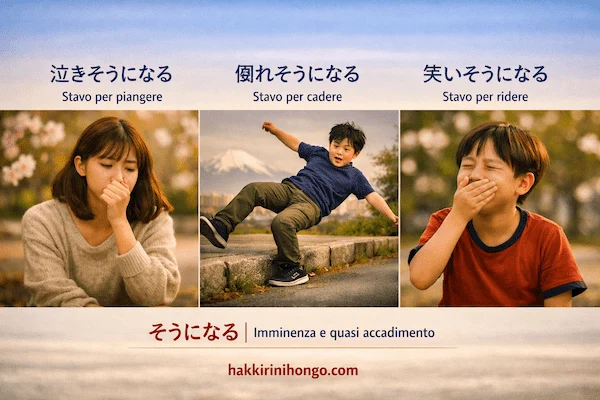
One of the forms most frequently compared with ところだった is そうになる (sou ni naru). Both can describe situations that come very close to the occurrence of an event, but they do not function in exactly the same way.
For a more detailed examination of the differences between the two, we refer readers to the article on the comparison between そうになる and ところだった.
For now, it is enough to say that そうになる is similar in expressing an imminent event, but it operates differently.
In summary:
Both indicate an event that almost happened, but they place emphasis on two different stages of the process.
- ~ところだった indicates that an event was about to occur but ultimately did not happen, often with the implication that a negative outcome was avoided;
- ~そうになる indicates that an event was on the verge of occurring. Literally, it conveys the idea that “there was a possibility that A would happen,” emphasizing the state of imminence.
Furthermore, ~ところだった is used with the affirmative (or negative) plain form of the verb, whereas ~そうになる is formed by attaching そう to the verb’s -ます stem.
Usage examples
車に轢かれるところだった。 もう少しで仕事を辞めるところだった。 危うく財布を忘れるところだった。 宿題をしないところだった。 あと少しで飛行機に乗り遅れるところだった。 試験に合格するところだった。 遅刻するところでしたが、間に合いました。 電話をかけるところだった。 電車の中で寝過ごすところだった。 危うく雨に降られるところだった。
Conclusions
In summary, ~ところだった is a construction used to indicate an event that was avoided by the narrowest of margins, with a strong sense of immediacy. Its formation (dictionary-form verb + ところだった) is straightforward, but its usage is idiomatic: it applies only when something did not happen even though it could very well have happened.
The grammatical analysis (「ところ」 + 「だった」) helps us understand the underlying mechanism (the “moment immediately before the action”), but the practical usage of expressing “almost” must be learned as a whole.
If you keep the following mental framework in mind: the event ahead + the threshold point + a retrospective viewpoint, the deeper meaning of the construction becomes much more transparent and much easier to use accurately.
Pragmatically, this construction allows the speaker to convey relief, regret, or simply a narrowly avoided reality. Compared with related expressions such as ~そうになる, ~ところだった focuses attention on the “last moment” before the event.
In light of everything we have seen, we can conclude that ~ところだった is an effective tool for highlighting events that were narrowly avoided. It is common, neutral in register, and its mastery requires understanding both its compositional logic and its broader idiomatic value.