Japanese Personal Pronouns: 私 (watashi), 僕 (boku), 俺 (ore), あなた (anata), and 君 (kimi) How to say “I,” “you,” “he,” and “she” in Japanese—and how your choice of pronoun reflects formality, familiarity, and social relationships
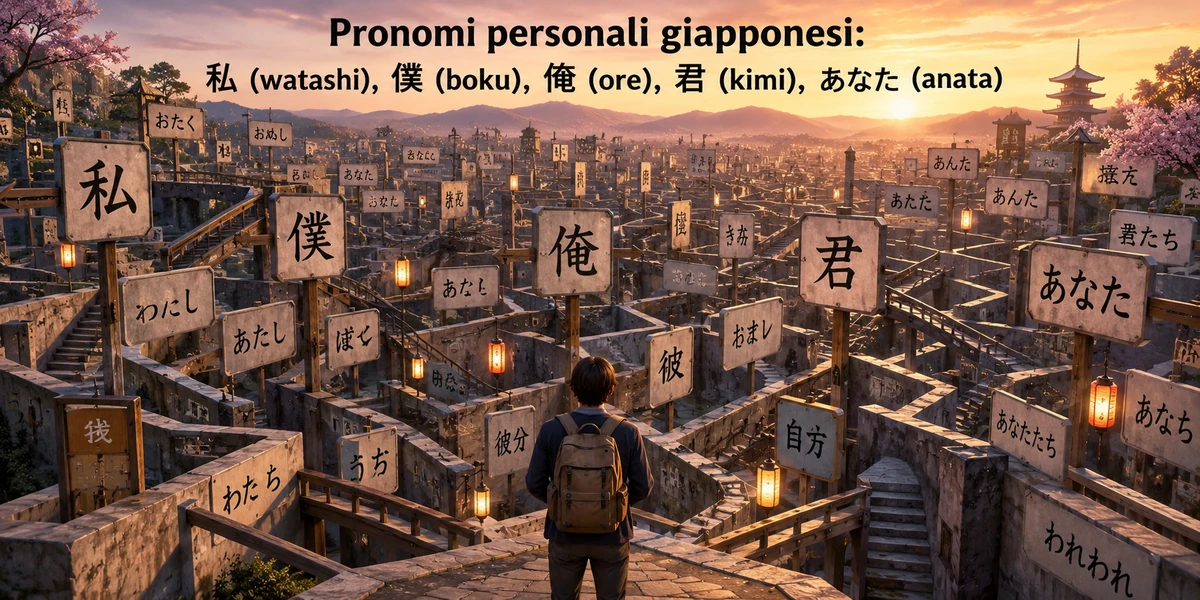
What are the Japanese personal pronouns for “I,” “you,” “he,” and “she,” and how do 私 (watashi), 僕 (boku), 俺 (ore), あなた (anata), and 君 (kimi) differ in meaning and use?
Japanese has a system of personal pronouns that differs considerably from those found in Western languages. To begin with, pronouns are often used sparingly: in conversation, they are commonly omitted when the intended meaning is clear from context.
For example, rather than explicitly saying “I” or “you”, speakers generally let the context make the subject clear or address the other person by name, with an appropriate honorific suffix. In effect, you address someone as though you were referring to them in the third person.
The choice of pronoun also depends on who is speaking, whom they are speaking to, and the circumstances. Japanese pronouns do more than identify grammatical person: they also convey information about formality, the speaker’s gender and age, and the social relationship between the people involved in the conversation.
For this reason, Japanese has a wide variety of pronouns (far more than a language such as English), each tending to be used in particular circumstances. One important point is that grammatical “person” (first, second, or third) plays a less central role in Japanese than it does in Indo-European languages.
Verbs do not change form according to grammatical person, and although Japanese has words corresponding to our personal pronouns, they behave more like ordinary nouns (so much so that some Japanese grammarians do not even classify them as a separate word class). Consequently, pronoun choice is governed more by pragmatics and register (formal or informal settings, familiarity, and so on) than by grammar alone.
Japanese personal pronouns are part of the language’s honorific system (敬語 keigo), in which respect and politeness shape every linguistic choice—from verb forms to vocabulary—including the terms speakers use to refer to themselves and others.
In this article, we will examine first-, second-, and third-person pronouns in detail, highlighting the masculine and feminine variants of each, their different levels of formality (from highly formal to very informal), and their uses in colloquial, literary, and archaic contexts.
We will also explore differences between spoken and written usage, with real-life example sentences, and compare pronoun choices across a range of social settings (the workplace, school, family, and friendships).
In the tables below, “Gender” indicates who typically uses the pronoun—M = primarily men, F = primarily women, M/F = both. “Register” indicates the level of formality.
Japanese Personal Pronouns: Differences and When to Use Them
To understand the differences between Japanese personal pronouns, we need to consider the level of formality, the degree of familiarity, and the social relationship between the people involved. Pronoun choice also conveys an attitude: the same form can convey closeness in an intimate relationship yet seem inappropriate when greater respect or distance is called for.
These nuances are already apparent in the different ways of saying “I.” 私 (watashi), 僕 (boku), and 俺 (ore) all mean “I,” but the choice between them changes both the tone of the sentence and how the speaker presents themselves. Watashi is common in neutral or formal situations and is used by people of all genders. Boku, used predominantly by men, tends to sound more informal and often gentler than ore. The latter is strongly colloquial and associated with masculine speech: it can sound perfectly natural among close friends but abrupt in relationships that call for greater deference.
The distinction between these personal pronouns therefore has practical consequences in everyday relationships. The same man might choose watashi during a professional presentation, boku in a less formal conversation, and ore among friends.
A pronoun helps express social distance, familiarity, and the speaker’s attitude toward the person they are addressing. An unsuitable choice can make someone seem excessively distant, overly familiar, or disrespectful, even when the rest of the sentence is grammatically correct.
When saying “you,” the relationship with the other person matters even more. あなた (anata) and 君 (kimi) are used in different contexts: anata is often taught as the equivalent of “you,” but using it directly requires care; kimi can express familiarity or affection, but may also suggest a sense of superiority. Just because a pronoun appears in a romantic line, a conversation between friends, or an anime does not mean it is automatically appropriate with a stranger, a teacher, or a superior.
With 彼 (kare), “he,” we move on to the person being spoken about. Here, too, we must decide whether to use the pronoun, repeat the person’s name, or use a title: what matters is clarity of reference and the respect due to the person mentioned. Depending on the context, kare can also mean “boyfriend,” a distinction that translating it simply as “he” would miss.
Choosing the right Japanese pronoun therefore means considering meaning, formality, and the relationship between the people involved, while also recognizing when omitting it would sound more natural. We will begin with the different ways of saying “I,” then look at how to address someone and how to speak about other people.
First-Person Pronouns – 私 (watashi), 僕 (boku), 俺 (ore)
Japanese has a particularly large number of first-person (“I”) pronouns, which clearly reflect the speaker’s gender and register. The following table lists the main terms speakers can use to refer to themselves:
| Pronoun (Kana/Kanji) | Gender of the speaker | Register (Formality) | Usage notes |
|---|---|---|---|
| 私 watakushi (私) | M/F (gender-neutral) | Highly formal | Equivalent to “I” in highly formal or ceremonial settings. Used in official speeches, business settings, and important documents. |
| 私 watashi (私) | M/F (gender-neutral) | Formal / neutral | The most common pronoun for “I.” Appropriate for all genders in formal or neutral situations; also the standard choice for women in almost any setting. |
| 僕 boku (僕) | Primarily M | Informal / polite | Used by men (and boys), particularly in informal or semiformal settings. Conveys modesty and a friendly tone. Rarely used by women, except sometimes to project a tomboyish persona. |
| 俺 ore (俺) | M (adults) | Very informal | Used almost exclusively by men in situations of considerable familiarity. Sounds blunt or vulgar in public or when used with strangers. |
| あたし atashi (私) | F | Informal | A colloquial feminine variant derived from “watashi.” Common in informal speech among women, but rarely used in formal situations or writing. |
| うち uchi (家/内) | F (regional dialect) | Informal | Used in casual settings, especially by girls and young women (widespread in the Kansai dialect). Literally meaning “home,” it can be used as a familiar way of saying “I.” |
| わし washi (儂) | M (older men) | Neutral / regional | Used by older men or to characterize elderly figures in stories. Lends speech an old-fashioned or regional flavor (often associated with western Japan). |
| 自分 jibun (自分) | M (also gender-neutral) | Neutral | Literally means “oneself.” Some men use it as a first-person pronoun, giving a somewhat detached, self-effacing impression. Jibun also functions as a reflexive pronoun (“oneself”) and, in the Kansai dialect, even as a second-person pronoun (“you”). |
| (own name) | M/F (children) | Informal | Young children often use their own name instead of “I,” either because it feels easier or because it sounds cuter. Some young adult women do the same to sound affected or childlike, but it is best avoided in serious situations. |
Note: There are also rarer and slang variants of “I.” For instance, おいら oira and おら ora are rustic colloquial forms (equivalent to ore and used in certain rural areas); わて wate (derived from watashi) is an obsolete Kansai dialect form; あたい atai is a highly informal alteration of atashi; 俺様 ore-sama, literally “my illustrious self,” appears almost exclusively in ironic contexts or comics to portray extremely arrogant characters. Classical or literary Japanese also had forms that are now archaic, such as 我 ware, 拙者 sessha, 余 yo, 吾輩 wagahai, and others, which we will discuss later.
How to Use “I” Pronouns: Differences in Register
As the table shows, the choice of first-person pronoun reveals a great deal about the setting. In formal or public situations, both men and women normally use watashi. On particularly formal or ceremonial occasions (official meetings, highly polite speeches, documents), speakers use watakushi, which sounds even more respectful and detached.
For example, a presenter or employee might say: 「私(わたくし)は田中と申します。」 (Watakushi wa Tanaka to mōshimasu.) – “My name is Tanaka.”
Here, watakushi signals a high degree of deference, combined with the humble verb mōsu (the humble form of “say” or “be called”)—typical of business or other formal settings.
In neutral or semiformal situations, watashi (私) is the safest and most widely applicable way of saying “I.” Anyone can use it in polite everyday interactions. For example, a woman can comfortably use it both at work and at home, while a man will use it at the office when speaking to superiors or in other formal situations.
Watashi is perceived as relatively neutral; however, because men have more informal alternatives available, women tend to use watashi more often in everyday casual speech, whereas men prefer other terms when circumstances permit (such as boku in less formal settings).
As familiarity increases, male speakers have pronouns specifically suited to more informal situations.
The most common is 僕 (boku), which suggests modesty and a cheerful, friendly manner. Boku is common among boys, students, and men in friendly or familiar settings, without sounding overly rough.
It is an informal but polite “I”: for example, a man might say to a colleague he knows well: 「僕はこのプロジェクトに賛成です。」 (Boku wa kono purojekuto ni sansei desu.) – “I agree with this project.”
A man would avoid boku in highly formal professional situations, but it is fairly acceptable in more relaxed modern workplaces or among colleagues of equal standing, lending a youthful tone. Adult women rarely use boku, although some women and girls may do so deliberately to challenge gender stereotypes or project a more masculine persona.
More informal still is 俺 (ore). This pronoun is strongly marked as masculine and familiar. Using ore implies considerable closeness or that the speaker feels sufficiently confident or secure in the relationship not to need polite language.
For instance, among close friends a young man might say: 「俺は昨日の試合を全部見たよ。」 (Ore wa kinō no shiai o zenbu mita yo.) – “I watched the entire match yesterday.”
Ore sounds natural in a situation like this. However, if the same speaker used ore with strangers or during a public speech, it would come across as rude or even vulgar. For that reason, ore should be avoided with strangers, superiors, or in public.
Even within a family, the use of 俺 depends on the relationships between members and their speech habits: many boys and men routinely use it with their parents without necessarily implying disrespect. In short, 俺 (ore) is a very informal “I,” suitable only for situations of considerable familiarity.
Alongside the neutral watashi, women also have feminine colloquial variants. The best known is あたし (atashi), essentially an alternative pronunciation of watashi used in an affectionate or informal tone.
Atashi conveys femininity and informality: for example, a girl chatting with her friends might say 「あたしは今日ちょっと忙しいの。」 (Atashi wa kyō chotto isogashii no.) – “I’m a little busy today.”
This pronoun commonly appears in speech and media dialogue, but rarely in formal writing. A formal text (such as a school essay or an article) written by a woman would use watashi, not atashi. There are also less common feminine slang forms, such as あたい (atai, an even more colloquial variant of atashi) or あたくし (atakushi, a mock-elegant variant derived from watakushi).
These latter forms sound distinctly marked today: atai evokes working-class speech or fictional characters, while atakushi can sound ironic or like the speech of an old-fashioned lady.
One particularly interesting case is うち (uchi). This word literally means “home” or “inside,” but in some regions (notably Kansai, the Osaka–Kyoto area), it serves as a familiar first-person pronoun, especially among young women.
For example, uchi occurs in sentences such as: 「うち、この服すごく気に入ってるねん。」 (Uchi, kono fuku sugoku ki ni itteru nen.) – in the Kansai dialect: “I absolutely love this outfit.”
Outside western Japan, uchi is still understood as “I” (particularly with a feminine nuance) and is sometimes adopted by young people elsewhere to sound fashionable or casual. In standard Japanese, uchi can also mean “our family/company.”
For example: 「うちの父は教師です。」 (Uchi no chichi wa kyōshi desu.) – “My father is a teacher” (here uchi means “my family/home”). Uchi therefore has some distinctive uses, but it remains one of the possible colloquial ways of referring to oneself.
Finally, as noted earlier, older men and certain male characters may refer to themselves as わし (washi). This pronoun immediately suggests old age or regional speech. A grandfather might tell his grandchildren: 「わしはもう年じゃ。」 (Washi wa mō toshi ja.) – “I’m an old man now.” (Ja is the dialectal copula used instead of da in many western Japanese dialects).
In stories, manga, and films, washi is often given to characters such as wise old men or retired samurai to characterize them. Outside such settings, it is not commonly heard from younger people.
Usage Examples – “I”
「私は田中と申します。」 (Watashi wa Tanaka to mōshimasu.) – “My name is Tanaka.” (Formal context: watashi is used by someone introducing themselves politely).
「僕はサッカーが好きです。」 (Boku wa sakkā ga suki desu.) – “I like soccer.” (Male speaker in a polite but informal setting: boku suggests a friendly, modest tone).
「俺に任せてくれ!」 (Ore ni makasete kure!) – “Leave it to me!” (Male speaker using a very informal, familiar tone: ore conveys confidence and closeness).
「あたしも行きたい。」 (Atashi mo ikitai.) – “I want to go too.” (Female speaker in a casual, informal setting: atashi conveys informality and femininity).
Second-Person Pronouns – あなた (anata), 君 (kimi), お前 (omae)
Japanese pronouns corresponding to “you” (singular or plural, formal or informal) may be even more difficult to navigate, because addressing someone with them directly can often be poorly received.
In formal contexts, directly addressing someone as “you” (especially with anata or similar pronouns) may sound condescending or impolite.
The general rule, therefore, is to avoid second-person pronouns and opt instead for the person’s first or last name with an honorific suffix (Tanaka-san, “Mr. Tanaka”), a title (sensei, “teacher”; buchō, “department manager”; okyaku-sama, “valued customer”, etc.), or a sentence in which the addressee is left implicit.
Only when you do not know the other person’s name at all, or have no other way of getting their attention, might you resort to anata and similar forms—and even then, cautiously. It is no coincidence that Japanese textbooks for foreigners often present あなた (anata) as the equivalent of “you,” although native speakers tend to use it very little in direct address.
With that in mind, let us examine the main second-person pronouns and how they are used:
| Pronoun (Kana/Kanji) | Gender of the speaker | Register | Usage notes |
|---|---|---|---|
| あなた anata (貴方) | M/F (all genders) | Formal / neutral | Means “you”; unlike English “you,” however, it is not a universally neutral form of address in Japanese and is by no means universally used, but it is by no means universally used in Japanese. It is sometimes used with strangers when their names are unknown, or in messages addressed to a general audience (for example, advertisements and brochures use anata as a generic “you”). In direct conversation it can sound somewhat distant; however, wives also commonly use anata as an affectionate way of addressing their husbands (equivalent to “dear”). |
| 君 kimi (君) | M (sometimes F) | Informal | Originally a respectful term meaning “lord” or “ruler,” it is now used as a casual “you.” Its tone is friendly but can suggest that the speaker is talking down to the listener: it is used toward people of equal or lower status, or affectionately by men toward their partners. Once a highly respectful term, it should now be avoided with superiors or strangers (where it would sound presumptuous). Speakers who address someone as kimi often call themselves boku (a typical combination in youthful masculine speech). |
| お前 omae (お前) | M (primarily) | Very informal | Literally “in front of you.” Used by men in very familiar relationships, it is an especially direct form of “you.” It implies that the speaker sees themselves as equal or superior in status to the addressee (or at least feels no need to show deference). Among male friends it can express camaraderie (“Hey, omae!” much like “Hey, buddy!”), but it is extremely rude when addressed to strangers or people of higher status. Some men, particularly from older generations, call their wives omae in private—an accepted usage in certain family settings, paralleling wives’ use of anata for their husbands. |
| あんた anta (貴方) | M/F | Informal | A colloquial contraction of anata. It often carries a hint of reproach or contempt. Women may use it in family arguments—for example, “Anta, what are you doing?!”—and it can also be used more generally in a harsh tone. Generally considered impolite (or suggestive of limited education) when used outside a close circle. |
| てめえ/手前 temē/temae | M (when used as an insult) | Offensive | An unmistakably insulting pronoun, comparable to “You little…!” Temē (a contracted pronunciation of temae) is used in moments of intense anger. Interestingly, temae was originally a humble first-person pronoun (“this humble person”) before shifting, ironically, into a contemptuous form of “you.” It should be avoided in any civil interaction. |
| 貴様 kisama (貴様) | M (when used as an insult) | Extremely offensive | Today it is among the harshest forms of verbal abuse (roughly “you bastard!”). Like temae, 貴様 (kisama) was originally a highly honorific expression (meaning “your august person”), but over time—and particularly after World War II—its use became sarcastic, expressing hatred or indignation toward the addressee. It frequently appears in anime and manga dialogue spoken by aggressive characters. |
Beyond these, some more specialized second-person pronouns occur in restricted contexts: for example, お宅 (otaku), literally “your home”, can be used as a polite yet distant way of addressing someone (“you,” comparable to a highly formal anata; today it is mostly historical or confined to certain forms of speech—the modern word otaku, meaning a geek or obsessive fan, developed from this usage because enthusiasts jokingly addressed one another as otaku).
Other forms appear almost exclusively in writing: 貴殿 (kiden) and 貴下 (kika) are sometimes used for “you” in formal letters or official documents (although they now sound old-fashioned). 貴官 (kikan) is used to address government or military officials, while 御社 (onsha) and 貴社 (kisha) respectively mean “your company” in formal speech and writing (used when addressing representatives of another company).
The last two expressions, however, are respectful ways of referring to the addressee’s company.
Using “You” Pronouns and Levels of Politeness
As we have seen, in contemporary Japanese, explicit second-person pronouns are often avoided, especially when speaking formally or honorifically. Addressing someone directly as “you” may be perceived as disrespectful.
Thus, in professional or institutional settings, or when addressing strangers in the street, it is standard practice to use the person’s surname or title: an employee, for example, will address a customer as Yamada-sama (“Mr. Yamada”) rather than “anata”; a teacher will call a student Tanaka-kun or use their given name, while the student will say Sensei (“teacher”) rather than “you.”
In general, it is preferable to omit the pronoun: sentences are often phrased impersonally.
For instance, instead of “Did you understand the lesson?”, one might simply ask 「分かりましたか?」 (Wakarimashita ka?, “Is that clear?”) without explicitly saying “you.”
The pronoun あなた (anata) is nevertheless used, particularly in contexts where it functions as a generic “you” rather than directly addressing a specific individual.
For example, anata is common in advertisements, brochures, and speeches aimed at a general audience (“Anata mo sūtsu o kitekita hō ga ii”, “You should come wearing a suit too”; or slogans such as 「あなたの未来を応援します」 anata no mirai o ōen shimasu, “We’re here to support your future”).
Here anata is translated as a generic “you,” much like the English “you” used to address any reader or viewer.
In direct conversation, anata may appear when someone genuinely does not know the other person’s name and needs to address them: for example, waiters sometimes use anata with regular customers (“Anata, itsumo arigatō”, “Thank you, as always”), or someone stopping a passerby might say: “Anata, chotto ii desu ka?”, “Excuse me, may I have a moment of your time?”.
Even in these circumstances, however, many speakers prefer expressions such as sumimasen (“excuse me”) without anata.
Anata is also used between spouses: wives are particularly known for using it to address their husbands as “dear” or “darling.”
For example, a wife might say to her husband: 「ねえ、あなた、今日の夕飯は何がいい?」 (Nē, anata, kyō no yūhan wa nani ga ii?) – “Hey, darling, what would you like for dinner tonight?”
Here anata expresses intimacy. A masculine counterpart might be omae (お前), used affectionately (although some modern husbands prefer to address their wives by name or with terms such as oyome-san, “wifey,” given how rough omae can sound).
君 (kimi) is particularly common in youthful speech and educational settings.
A teacher may address a student as kimi (instead of name + kun) in informal situations, while a father may call his teenage son kimi as an affectionate yet authoritative “you.”
In romantic relationships, kimi can be a term of endearment: a classic romantic line is 「君が好きだ」 (Kimi ga suki da) – “I like you”, the kind of familiar declaration a young man typically makes to a girl.
Notice that in these cases the speaker will almost certainly refer to himself as boku, forming the boku-kimi pairing.
Kimi is not used exclusively by men, however: some women also use it with close female friends (especially those with outgoing personalities), although this is less common. Kimi should not be used in formal settings or by someone addressing a superior: calling your boss kimi would sound profoundly disrespectful.
お前 (omae) is very common in informal conversations among men and once had a derogatory tone (which it has retained to some extent).
It is roughly equivalent to a rough, familiar “hey, you” and is used between male friends who know one another well, often with teasing or good-natured roughness. A man might laugh and tell his friend: “Omae, don’t get carried away now!”
However, omae also implies a sense of superiority on the speaker’s part: it is a form of “you” that can sound aggressive.
Indeed, it is a favored way of addressing someone during an argument or in harsh remarks: for instance, 「お前は何も分かっていない!」 (Omae wa nanimo wakatte inai!) – “You don’t understand a thing!” (perhaps said by an angry character in a film). Omae is distinctly offensive when used with older people or those in higher positions.
Some mature men continue to use omae with their wives or friends well into adulthood (particularly when it is part of their local dialect or family culture), but they carefully avoid it in formal public situations.
Anta (あんた) is often heard in heated family arguments or angry exchanges: for instance, a mother might scold her child by saying 「あんた、またゲームしてるの!?」 (Anta, mata gēmu shiteru no!?) – “You! Playing video games again?!” in an exasperated tone.
Or two acquaintances might argue: “Anta ni wa kankei nai desho!!”, “It’s none of your business!”. In these situations, anta clearly conveys anger or contempt, with a force comparable to omae, and sometimes even stronger, especially because it is often used by angry women (which may be culturally even more surprising, given the expectation that women should speak more gently). Anta is not advisable outside these contexts.
In extremely informal or openly insulting language, temē and kisama are fighting words. Temē often appears in lines such as 「このてめえ!」 (Kono temē!) – “You bastard!” in anime fight scenes. Kisama may appear in historical combat scenes or villains’ dialogue: for instance, 「貴様ら、許さん!」 (Kisama-ra, yurusan!) – “You bastards, I’ll never forgive you!”. As you can see, kisama can also take a plural form (kisama-ra).
In everyday life today, you are unlikely to hear these words except perhaps from troublemakers or in physical confrontations—they are firmly taboo in polite speech.
Usage Examples – “You”
「先生のご意見を伺いたいです。」 (Sensei no go-iken o ukagaitai desu.) – “Professor, I’d like to ask your opinion.” (Sensei is repeated rather than using anata).
「君は本当に面白い人だね。」 (Kimi wa hontō ni omoshiroi hito da ne.) – “You’re a really interesting person.” (Friendly use of kimi; the speaker—probably a young man—is informally complimenting a friend or his girlfriend).
「お前は何様のつもりだ?」 (Omae wa nani-sama no tsumori da?) – “Who do you think you are?!” (Reproachful or hostile tone; omae expresses contempt here).
「あんた、いい加減にしてよ。」 (Anta, iikagen ni shite yo.) – “That’s enough already, will you?” (An angry remark, perhaps from a wife fed up with her husband’s behavior. Anta makes the rebuke more direct).
Third-Person Pronouns – 彼 (kare), 彼女 (kanojo), and Others
To refer to the third person (“he/him”, “she/her”, “they/them”), modern Japanese has several dedicated pronouns, but they are used less extensively than their equivalents in English.
Rather than using a pronoun such as “he” or “she,” speakers often prefer to mention the person by name, perhaps adding the honorific -san (Mr./Ms.) or a title.
In many cases, expressions such as ano hito (“that person”) are also used instead of a generic pronoun. This is especially true when ambiguity is possible.
For example, simply saying “he” in Japanese (kare) may be unclear unless it is already clear who is being referred to, so speakers tend to repeat the name. This helps explain why third-person pronouns, although they exist, are less frequent.
The main singular third-person pronouns are:
-
彼 (kare) – means “he/him”. It functions both as a pronoun (“he”) and as a noun meaning “boyfriend.” Originally, kare (written with the kanji 彼, meaning “that”) was a general demonstrative (“that person over there,” regardless of gender), and in classical texts it could refer to a woman or even a thing.
In modern Japanese, it has acquired the specific meaning of the masculine pronoun “he” and the noun “boyfriend.”
For example: 「彼は医者です。」 (Kare wa isha desu.) – “He is a doctor.”
Or: 「田中さんは彼と映画に行った。」 (Tanaka-san wa kare to eiga ni itta.) – “Ms. Tanaka went to the movies with him.”
In the second example, 彼 could refer to Tanaka’s boyfriend, but it could also simply mean a man already known from context. The distinction between the pronominal meaning and the romantic-partner meaning therefore depends on context.
-
彼女 (kanojo) – means “she/her”. Like kare, kanojo is used both as a pronoun (“she”) and to mean “girlfriend”. Kanojo is a relatively recent term, coined during the Meiji era (late nineteenth century) specifically to translate the English “she”—traditional Japanese had no pronoun specifically meaning “she.” The kanji spelling 彼女 combines 彼 (“that”) and 女 (“woman”), literally “that woman.”
Examples: 「彼女は学生です。」 (Kanojo wa gakusei desu.) – “She is a student.”
Or: 「山田さんの彼女は教師です。」 (Yamada-san no kanojo wa kyōshi desu.) – “Mr. Yamada’s girlfriend is a teacher.”
In the second example, kanojo explicitly means “girlfriend.” Note that although kare/kanojo are the closest Japanese equivalents of English “he” and “she”, they are relatively uncommon in formal written Japanese: formal texts often repeat the person’s name or use expressions such as 本人 (honnin, “the person concerned”) to avoid confusion.
-
あの人 (ano hito) – literally “that person”. This is a common, neutral way of referring to someone in the third person without specifying gender.
For example: 「あの人は有名な歌手です。」 (Ano hito wa yūmei na kashu desu.) – “That person is a famous singer.”
Depending on context, it could also be translated as “he/she is a famous singer.” Ano hito is useful because it conveys neither excessive formality nor excessive familiarity: it is relatively polite (especially when referring to someone who is not present).
In more polite situations, however, an honorific variant is preferred: あの方 (ano kata) – “that person (honorific).”
-
Kata (方) literally means “direction/side”, but it is also used as a respectful word for “person,” conveying deference toward the person being referred to.
Ano kata is a respectful equivalent of “that person,” used when referring to someone toward whom one wishes to show deference (for instance, the head of another department: ano kata allows the speaker to avoid naming them directly while maintaining an honorific tone).
Example: 「あの方はこの会社の社長です。」 (Ano kata wa kono kaisha no shachō desu.) – “That person is the president of this company.”
Here, ano kata expresses respect for the president being mentioned.
-
彼ら (karera) – “they/them” (masculine or generic). This is the plural of kare, formed with the suffix -ra. It refers to a male or mixed-gender group.
For example: 「彼らは大学の同級生です。」 (Karera wa daigaku no dōkyūsei desu.) – “They are university classmates.”
If the group is known to consist entirely of women, 彼女たち (kanojo-tachi)—simply kanojo with the plural suffix -tachi—can be used to mean “they (women).”
Nevertheless, karera is often sufficient for “they” in general. In formal sentences, both karera and kanojo-tachi are sometimes avoided in favor of expressions such as 一同 (ichidō, “all of them”) or similar alternatives, although both forms are widely understood and used in speech.
-
こいつ/そいつ/あいつ (koitsu/soitsu/aitsu) – these are highly informal colloquial pronouns belonging to the kosoado system (こそあど), which we will return to later. They correspond roughly to “this guy, that guy near you, that guy over there”.
In practice, koitsu means “this guy here,” soitsu means “that guy there (near you),” and aitsu means “that guy over there.” They are used to refer to people in a contemptuous or very familiar way.
Among friends, for example, someone might jokingly pat another person on the back and say: 「こいつは俺の親友だ。」 – “This guy is my best friend.”
Here, koitsu is teasing or affectionate. Be careful, though: referring to someone as koitsu/aitsu in the third person while they are present may be offensive, because it can imply that you regard them as an object or as beneath you.
These words often appear when speaking about someone with anger or contempt: for instance, 「あいつらは最低だ!」 (Aitsu-ra wa saitei da!) – “Those guys are the worst!”
The suffix -ra makes them plural (“those guys”). These forms are common in anime and manga when expressing hostility between rivals or a very casual tone. In real life, they should only be used in extremely familiar situations and never when referring to someone to whom respect is owed.
Besides the pronouns already mentioned, 奴 (yatsu) is also worth discussing. Yatsu literally means “guy/fellow” (written with the kanji 奴, originally meaning “servant”) and is used as a colloquial noun meaning “that guy” or “that fellow.”
For example, 「例の奴はどうなった?」 (Rei no yatsu wa dō natta?) – “Whatever happened to that guy we were talking about?”
Yatsu does not specify gender and is rather coarse and informal. With -ra, it becomes yatsura (“those guys”). Yatsu is often used instead of aitsu, but aitsu functions more like a pronoun, whereas yatsu is an ordinary noun (“a guy”). In any case, neither yatsu nor aitsu is appropriate in formal situations.
In formal or otherwise polite situations, if you need to refer to third parties without naming them, ano kata (discussed earlier) is a safe choice. One formal alternative for “they” (third-person plural) is ano kata-gata (with the honorific plural suffix 方 -gata), or expressions such as 皆様 mina-sama (“all of you,” which may also mean “all of them” when referring to a third-party group).
Often, however, the preferred strategy is to restructure the sentence to avoid the pronoun altogether: rather than saying “They think that…”, for instance, one could identify the group directly: “According to [name of the group], …”.
Usage Examples – “He/She/They”
「彼は学生ではありません。」 (Kare wa gakusei dewa arimasen.) – “He is not a student.” (Kare is used to mean “he”).
「田中さんの妹は大学生です。彼女は東京に住んでいます。」 (Tanaka-san no imōto wa daigakusei desu. Kanojo wa Tōkyō ni sunde imasu.) – “Tanaka’s younger sister is a university student. She lives in Tokyo.” (Here 彼女 refers back to the person already mentioned, without meaning “girlfriend”).
「山田さんと彼女は来月結婚します。」 (Yamada-san to kanojo wa raigetsu kekkon shimasu.) – “Mr. Yamada and his girlfriend are getting married next month.” (Kanojo means “his girlfriend”).
「木村夫妻はフランスにいます。彼らは今パリに住んでいます。」 (Kimura fusai wa Furansu ni imasu. Karera wa ima Pari ni sunde imasu.) – “Mr. and Mrs. Kimura are in France. They currently live in Paris.” (An example of karera meaning “they,” referring to a couple).
「あの人は英語の先生です。」 (Ano hito wa Eigo no sensei desu.) – “That person is an English teacher.” (Ano hito means “that person (he/she)”).
「社長、あの方をご存知ですか。」 (Shachō, ano kata o gozonji desu ka?) – “President, do you know that person over there?” (Literally “that direction (方),” used as a respectful term; ano kata in a formal question).
Plural Pronouns and Pluralizing Suffixes
Japanese generally does not have a completely separate set of plural pronouns (such as “we/you/they”) independent of the singular forms: instead, a pluralizing suffix is typically attached to a singular pronoun to produce the plural.
-
The most common suffix is 達 -tachi, used in informal or neutral settings. It can be attached to both pronouns and names.
For example, watashi (“I”) becomes 私達 watashi-tachi (“we”), anata (“you”) becomes あなた達 anata-tachi (“you” plural), 君たち kimi-tachi = you (informal plural), 彼女たち kanojo-tachi = they (female group), and kare (“he”) becomes 彼ら kare-ra (“they”)—in the last case, the suffix -ra is used, as we saw earlier.
It can often be understood as “and the others” or “and the group”: for example, Tarō-tachi means “Tarō and his friends/his group.”
-
-ら (-ra) – another plural suffix, typically used with informal pronouns.
Examples: 僕ら bokura = we (colloquial masculine); 俺ら orera = we (very colloquial, rough masculine speech); お前ら omae-ra = you (very informal plural, potentially aggressive: “you lot”). -ra often has a disparaging or highly familiar nuance, so it is particularly common with terms such as omae (“omaera,” a rough “you lot”) or negative expressions (yatsu-ra, “those guys/those bastards”).
It can, however, be neutral with kare: karera (“they”) is perfectly normal.
-
-方/-方々 (-kata/-gata) – an honorific plural suffix. Adding 方 (-kata, which often undergoes rendaku and becomes -gata) produces a respectful plural form.
A typical example is あなた方 (anata-gata), a polite way of saying “you” in the plural (more respectful than anata-tachi).
This suffix is NEVER used to refer to oneself, because it would amount to using an honorific for oneself (elevating one’s own status, which is inappropriate).
For example, watashi-gata would be incorrect. It can, however, be used with “they”: ano kata-gata (“those people,” respectfully), or with names: Tanaka-gata (“Mr. Tanaka and his associates”).
In practice, -gata is not especially common in everyday conversation, but it occurs in formal speeches and formal writing.
-
-ども (-domo) – a humble or derogatory plural suffix. Added to watakushi or watashi (watakushi-domo, watashi-domo), it means “we” with a modest, self-deprecating nuance (“we humbly…”).
It is used to lower oneself and one’s own group relative to the addressee: for example, a company representative might say watakushi-domo when referring to the company, with a self-effacing sense of “we.”
Be careful, though: -domo literally means “companions,” but it also lowers the status of the people referred to, so using it inappropriately for others can sound offensive (as though saying “those wretches…”).
It often appears in set expressions of humility (watashi-domo, ware-ware-domo). It is less common today, but still exists.
我々 (wareware), meaning “we (as a collective group)”, is also worth mentioning.
It is formed by repeating the character 我 (“I/we”), and it is frequently used in official speeches or statements made on behalf of a group.
For example, wareware Nihonjin – “we Japanese.”
Wareware lends speech a formal or solemn tone, making it suitable for press conferences, for example; it also appears in general statements (such as wareware wa uchū kara kita – “We come from outer space,” a classic line spoken by aliens in films).
By contrast, 我ら (warera) is a more literary or poetic variant of “we”, found in written works or emphatic speeches (for example, patriotic songs, warera Nihon kokumin… “we, the citizens of Japan…”). It is not used much in everyday speech.
For the second-person plural, as already noted, anata-tachi (“you” plural) or the more respectful anata-gata can be used. In informal settings, speakers may use omae-tachi (a very familiar “you” among friends) or kimi-tachi.
However, when addressing a group directly (such as a class or an audience), Japanese speakers often prefer minna-san (literally “everyone,” equivalent to “all of you”) or identify the group by name: for example, 皆さん、聞いてください “Everyone, please listen.”
Thus, plural “you” is often left implicit.
For the third-person plural, we have already seen karera (“they”) and kanojo-tachi (“they,” referring to women). Ano hito-tachi (“those people”) is also commonly used.
Another general expression that is especially useful to know and understand is minna (みんな), meaning “everyone”. Depending on context, it can correspond to either “you” or “they”, but it is not a formal personal pronoun; rather, it is a collective noun.
In short, pluralization in Japanese is more morphological (adding suffixes) than lexical. There is no completely different independent form corresponding to “we” as opposed to “I”: instead, you get watashi-tachi, and so on.
This system is flexible (you can also say Tanaka-tachi to mean “Tanaka and the others”).
The key is to choose the suffix that suits the register: -tachi covers most informal and neutral situations, -ra is used colloquially or when the base pronoun is kare/are (giving karera, arera), -gata signals respect (with plural “you”), and -domo conveys humility when referring to oneself and one’s group.
Colloquial, Literary, and Archaic Pronouns
As we have seen, contemporary Japanese favors certain pronouns in casual speech while avoiding others in formal contexts. There are also literary and archaic pronouns no longer used in everyday conversation, although they still appear in books, period dramas (historical films and television series), or when a particular stylistic effect is desired.
Colloquial and Slang Forms
Colloquial speech includes pronouns such as boku, ore, atashi, anta, and omae—all the informal forms listed above. Among friends, within families, and in spontaneous conversations between equals, it is normal to hear ore or boku from men, watashi or atashi from women, and direct second-person pronouns such as omae among male friends or anta during family arguments.
It is important to recognize that these choices also vary by region and dialect: uchi as “I” is a regional colloquial form (Kansai); washi is regional (Chūgoku/Shikoku, used by older people); anta is common in Kantō (Tokyo), while some Kansai dialects also use jibun for “you” (in certain parts of Kansai, jibun means “you,” unlike its standard meaning of “oneself”).
Some slang pronouns can also signal affiliation with a subculture: in contemporary youth communities, some people adopt unusual pronouns to express their identity. For example, girls known as ボクっ娘 (boku-kko) refer to themselves as boku to sound “easygoing” or distinctive; conversely, shy boys may use watashi even among friends as a matter of personal style.
Forms such as ore-sama also appear in jokes (deliberately putting on airs, perhaps during role-playing games or among friends in comedic situations).
In informal speech, syllables are often contracted: this explains forms such as anta (from anata), temee (from temae), ore sometimes written in katakana (オレ) to emphasize its rough tone, and omē (おめえ), a dialectal variant of omae, among others. These are not new pronouns but altered pronunciations typical of rapid or dialectal speech.
Another colloquial way of referring to oneself—as mentioned earlier—is to use one’s own name. This occurs almost exclusively in children’s speech or within families.
For example, a little girl named Kana might tell her mother: 「かなね、今日公園に行きたい!」 – “Kana wants to go to the park today!”, referring to herself in the third person.
This sounds childlike or deliberately cute; indeed, many children gradually stop doing it as they grow older. Some young women, however, occasionally retain this way of speaking in intimate situations to sound cute or innocent (for example, saying to someone: 「麻美は寂しいな〜」 – “Mami feels lonely…”, referring to herself).
In general, this habit can seem odd outside close, affectionate relationships.
Literary and Archaic Pronouns
Classical Japanese literature and historical contexts featured a rich repertoire of pronouns that sound old-fashioned today. Some notable examples are:
-
吾輩 (wagahai) – a pompous first-person pronoun, equivalent to a haughty “we” or “I, the great one.” It was made famous by Natsume Sōseki’s 1905 novel “吾輩は猫である” (Wagahai wa neko de aru) – “I Am a Cat,” in which a talking cat uses wagahai to make himself sound important. Today, wagahai is not used in spoken Japanese except ironically, but it remains emblematic of Meiji-era literary language.
-
拙者 (sessha) – a humble first-person pronoun meaning “this inept person.” Samurai used it during the feudal period to refer modestly to themselves among their peers. It frequently appears in samurai films: a warrior says “Sessha…” instead of “Watashi.” Today, its main purpose is to characterize a speaker as a samurai or to recreate historical speech in role-play. For example, sessha might appear in a line such as 「拙者、某(それがし)と申すは…」 – “I, humbly known as So-and-so, am…”
-
某 (soregashi) – an archaic first-person pronoun (written with a kanji meaning “a certain person”), likewise used by samurai or in literary contexts in the sense of “the undersigned.” It is thoroughly obsolete today.
-
我 (ware) – an ancient word for “I” (from which comes wareware, “we,” discussed earlier). Ware appears in many idiomatic expressions and classical texts, and survives today in fixed phrases such as ware wo wasure (“forgetting oneself”). In modern speech, ware alone as “I” is extremely rare outside poetry, while as “yourself” it appears in the proverb “Onore wo totonoe, ware wo motte hito wo totonō” (respect yourself and [only then] others will respect you).
-
私 (わたくし, watakushi) – besides its modern use as a formal pronoun, watakushi also appears in Japanese literature as a narrator’s first-person pronoun.
One significant example occurs at the beginning of Natsume Sōseki’s こころ (Kokoro):
私(わたくし)はその人を常に先生と呼んでいた。
“I always called that person ‘Sensei.’”
Here, watakushi directly identifies the narrative voice. Its use does not necessarily express deference toward an addressee; instead, it helps establish the tone of the narration. In literature, the choice between watakushi, watashi, and other first-person pronouns may depend on the style of the work as well as the narrator’s identity.
Thus, in written literary contexts, watakushi and watashi are common and are not necessarily perceived as formal, but simply as first-person forms used by the narrator.
-
汝 (nanji) – an archaic second-person pronoun corresponding to the biblical “thou” (an elevated or poetic “you,” sometimes rendered as a plural or formal “you” in older translations). It occurs in ancient texts, prayers, epitaphs, and the grandiose speeches of historical characters in works of fiction. Nanji is the equivalent of the archaic English pronoun thou. For example, the famous biblical phrase “汝の敵を愛せよ” – “Love your enemy” – uses nanji for “you.”
-
お主 (onushi) – literally “your lordship.” It was used before the Meiji era, particularly by samurai or older people, to address someone of equal or lower status with a degree of familiarity (rather like a somewhat gruff “my dear fellow”).
In chanbara films, an elderly clan leader might say to a young warrior: 「お主も若いのう…」 – “You’re still young, lad (and inexperienced)…” Today, onushi sounds decidedly archaic and appears only in historical narratives or as a joke.
-
其方 (sonata/sochi) – a respectful but archaic second-person pronoun, literally “that direction.” Sonata was once used as a polite form of “you,” but today it sounds pompous and anachronistic, perhaps even slightly condescending.
In historical dramas, sonata is used by nobles addressing someone of slightly lower rank while maintaining a certain distance (for example, a feudal lord asking a samurai, “Sonata wa nani mono da?”, “Who might you be?”, in a formal tone). Sochi is a similar but much less common variant.
In modern literature, 僕 (boku) also has a distinctive role as a narrative pronoun. Many contemporary novels (particularly from the twentieth century onward) use boku for a young male narrator to create a colloquial, intimate tone.
For example, Nobel laureate Kenzaburō Ōe wrote a novel entitled “僕が本当に若かった頃” (“When I Was Really Young”), and Haruki Murakami often uses boku for his first-person narrators in the Japanese originals of his works (even though it may simply be translated as “I” in English). This narrative boku creates a distinctive voice, almost as if the character were speaking directly to the reader in his everyday language.
It is also worth noting that manga and anime frequently use pronouns as a tool for characterization: a shy or refined character might use watashi, an energetic young man might use boku, a delinquent might use ore, a sweet girl atashi, while a robot might call itself watakushi to exaggerate its formality, and so on.
As a result, anime fans sometimes become familiar with forms that would otherwise be rare in real life.
In short, archaic and literary pronouns are important for understanding historical texts and certain conventions of popular culture, but they should not be used in modern everyday conversation unless you want to sound peculiar. They are useful to recognize, however: words such as wagahai, sessha, onushi, nanji, and kisama evoke the flavor of bygone eras or particular contexts in Japanese.
Differences Between Spoken and Written Japanese
The way personal pronouns are used can vary considerably between spoken and written Japanese. In everyday speech, as we have repeatedly seen, pronouns are commonly omitted whenever possible.
For example, two friends looking at the sky have no need to say “I think it’s going to rain”; one can simply say “ame furu kamo” (“it might rain”) without the pronoun “I,” and the other will understand just as well.
Spoken Japanese is highly context-dependent and closely tied to the immediate situation. Moreover, when pronouns are expressed in casual settings, they are often informal forms such as boku, ore, atashi, anta, and omae. The choice is adjusted to the relationship (friend, family member, or stranger).
In formal speech (for example, a business presentation), pronouns are kept to the bare minimum, with titles or neutral forms preferred. An airport announcement, for instance, will not address passengers as “anata,” but will use “mina-sama” or impersonal formulations (“Tōjō oannai o itashimasu”, “Passengers are advised that boarding…”).
In writing, different registers must be distinguished. In formal written styles (such as newspaper articles, essays, and textbooks), avoiding personal pronouns altogether is even more common.
For example, Japanese newspapers often repeat a person’s surname or title instead of using “he/she”: “安倍首相は記者会見で… 首相は…” (“Prime Minister Abe stated at a press conference… The prime minister then…” [rather than “he”]).
This is because kare/kanojo could create ambiguity (who is being referred to? the subject may change), and a more nominal style is generally preferred. In academic, technical, or scientific texts, “I” (watashi) is also usually avoided: the author writes impersonally or uses 筆者 (hissha, “the author”) if a self-reference is necessary, or sometimes watakushi in prefaces to sound respectful without being overly subjective.
In correspondence (letters and emails), pronoun choice depends on the degree of formality: in a friendly email, a Japanese speaker may use watashi/boku for “I” and perhaps kimi (or the recipient’s name) for “you,” whereas a formal letter is more likely to use watakushi for the writer and 貴殿 (kiden), 貴社 (kisha), or similar expressions for “you/your company” when referring to the recipient—or avoid such references altogether, for example by opening with “平素より大変お世話になっております” (“Thank you for your continued support…” without mentioning “you”).
In literary fiction, as noted earlier, choosing the narrator’s first-person pronoun is part of an author’s style. Some writers alternate between watashi and boku to change the narrative voice from one novel to another. Others use ore for grittier, rawer narratives.
In English translation, these variants often all become “I,” but in Japanese they convey different nuances. For example, Osamu Dazai’s famous novel No Longer Human alternates between watashi and jibun in different chapters to convey the protagonist’s emotional detachment.
Another difference between speech and writing is that creative or poetic writing can use more old-fashioned language without sounding strange, whereas the same language would sound anachronistic in conversation.
For example, a character in an epistolary story set in the nineteenth century might use watakushi and anata in the letters reproduced in the story, which works perfectly well on the page; but if someone spoke that way aloud today, they would sound as though they belonged to another era.
To summarize:
- Speech tends to be elliptical (pronouns are omitted) and adjusted to the immediate interpersonal relationship;
- Formal writing avoids direct pronouns and favors more explicit references or impersonal constructions;
- Narrative and literary writing can exploit pronoun choice for stylistic effect.
The example sentences presented so far largely reflect spoken Japanese (dialogue). If we were to put them into a formal document, some probably would not appear at all, while others would be rephrased to remove pronouns.
Pronoun Use in Different Social Settings
To better understand what we have discussed, it helps to see how personal pronouns vary according to the social setting—in other words, who is speaking to whom, and where. Usage changes across family life, work, school, friendships, and other social settings. This is part of what linguists call register or situational context.
The Workplace (Formal Professional Settings)
Communication in a traditional Japanese company is highly formal. Employees almost always refer to themselves as watashi; in more formal formulations, they may instead use their own surname and position or self-effacing expressions equivalent to “the undersigned.”
For example, in a meeting an employee will use watashi when referring to themselves while speaking to the boss, and watakushi if the meeting is particularly formal or involves external guests. A man might use boku only where the corporate culture is relatively relaxed and he is among younger colleagues of equal standing—never with the company president or customers. Women use watashi regardless of the level of formality (some very young women might use atashi with close female colleagues over lunch, but retain watashi in the office).
For the second person, directly addressing someone as “you” is virtually unheard of: colleagues are addressed by surname + san/senpai/sensei, etc.; superiors by their titles (buchō, “department manager”; shachō, “company president”); and customers as okyaku-sama (“valued customer”) or through indirect phrasing.
For instance, instead of “Did you bring the documents?”, a manager might ask a subordinate “資料は持ってきましたか” (“Did you bring the documents?”) without an explicit “you,” or “田中君、資料は?” (“Tanaka-kun, the documents?”).
In short, names and titles take the place of pronouns in formal workplace interactions.
When speaking about third parties in the office, titles are used: 課長は… (“The section chief [he]…”) rather than kare.
In formal dealings between companies, as mentioned earlier, expressions such as onsha, kisha (“your company”), and hei-sha (“our humble company”) are used instead of direct “you/we.” Overall, formal workplace Japanese tends toward a degree of linguistic depersonalization: personal pronouns give way to social roles.
School (Educational Settings)
School is less formal than the workplace, but status differences still matter (teachers versus students, senior students versus newcomers, and so on).
When speaking to teachers (先生 sensei), students use polite language and watashi (even boys in middle and high school often answer teachers using the neutral watashi during oral examinations).
Some more relaxed boys may use boku if they have an informal relationship with a teacher (for example, in a school club with a young coach), but they would never use ore with a teacher—it would be considered rude.
Female students normally use watashi in class (atashi is less common in school settings today, except among friends). Outside the classroom, however, boys often switch to ore with their close male friends and boku with less intimate friends or girls, so as not to sound too cocky.
Among themselves, girls use watashi, their own nicknames, or uchi, which has spread beyond Kansai. An interesting finding comes from a study conducted in 2008 among elementary school pupils in the Kantō region and published in 2009 by Yuko Saegusa: among the girls surveyed, 86% used watashi in class, whereas in conversations with friends 49% used uchi, 26% used their own names, and 15% used atashi.
This shows that children learn from an early age to adapt their pronouns to the situation (formal in front of a teacher, more informal with friends).
For the second person, students address their teachers as Sensei (“Teacher”) or use their name + sensei (“Ms. Suzuki”) and never anata.
Among classmates, students use nicknames or surname + san/kun, or omae and anta with very close friends or during arguments. In everyday student conversation, omae may be common among boys (in a friendly, matey tone), and anta among girls when teasing or irritated.
Again, however, such forms stay within the circle of friends: a student would not call a stranger they met at an interschool competition omae—they might use kimi instead, to remain neutral and informal.
When referring to third parties at school, students tend to use their classmates’ names (“Did you see what Yuki did?” rather than “Did you see what she did?”). A teacher discussing one student with another might say “Tanaka-san wa…” rather than “kare wa…”.
Family
At home, relationships are intimate, so pronouns are at their most informal—or disappear altogether.
Family members often address one another by their family roles: a wife may call her husband otō-san (お父さん, “Dad”) if they have children, or use his name or nickname; a husband may call his wife okā-san (“Mom”) in front of the children, or use her name, or omae in private.
Children call their parents otō-san (“Dad”) and okā-san (“Mom”), and parents often refer to themselves in the third person using these terms when speaking to young children (“Mommy’s coming now”).
As children grow older, they may start calling their fathers otōchan or oyaji (more casual forms of “Dad”); fathers, in turn, may use ore when speaking to them, while mothers generally continue to use watashi or atashi.
Among siblings, when there is a considerable age difference, the younger sibling may use -nii or -nee (“big brother,” “big sister”), while the older one might use omae with the younger one (especially an older brother addressing a younger brother), or call them by name. Siblings of similar ages, and friends as close as siblings, often use ore/omae.
In general, within a family you might hear ore from the father, watashi/atashi from the mother, boku/ore from sons, watashi/atashi from daughters, and omae/anta during arguments.
For example, an angry father might say to his son: 「お前、いい加減にしろ!」 – “Hey, you! Cut it out!”
Or an irritated wife might say: 「あんた最近帰り遅いよ」 – “You’ve been coming home late lately” (the “you” subject need not be translated separately, but anta conveys something like “Listen here, you…”).
In traditional families, wives commonly addressed their husbands as anata even in front of the children (many Japanese households used to echo with “Anata…” in conversations between middle-aged spouses), whereas younger couples today tend to address each other by name or nickname.
It is worth noting that some older people (especially in rural areas) use dialectal pronouns at home: a grandfather may call his wife omae without intending any offense and refer to himself as washi; in rural parts of Tōhoku, some people use ora for “I” and ome for “you” at home (dialectal variants of ore/omae). There is therefore considerable variety within families, but always at the informal end of the spectrum. Formal forms such as watakushi or anata are generally used at home only ironically or when addressing someone outside the family (for example, a guest—but then the family is addressing the guest, not one another).
Among Friends
Within groups of friends, especially teenagers and young adults, speech is very informal. People tend to use the first-person pronoun that best reflects their identity within the group: more easygoing boys will use ore, quieter ones boku (and may be good-naturedly teased for using watashi, considered too formal among male friends).
Among female friends, girls use watashi or atashi if that is what everyone does; some may use boku to project a more modern image, which is also accepted in casual peer groups. Among friends, first-person pronouns can almost become personal trademarks: there may be a girl known for referring to herself in the third person, or a boy who jokingly flaunts ore-sama, and so forth.
For “you,” omae is often tossed around between close male friends, sometimes as nothing more than an affectionate form of address (“What are you talking about, omae?” is rather like saying “What the hell are you on about, you idiot?” with a smile). Among female friends, anta may appear in teasing remarks (“Oh, anta, you’re such a character!”).
Kimi is not usually used between friends—it sounds either too intimate (romantic) or slightly patronizing; it may turn up, however, when someone in the group starts acting like a “poet” or imitating anime dialogue.
Very often, friends use nicknames or given names directly instead of “you”: in Japan, it is common for close friends to call one another by a nickname + -chan or -kun, which effectively replaces the pronoun.
For example, two classmates who are friends might say: “Ken-chan, ashita eiga ni ikō ze” – “Hey Ken, let’s go to the movies tomorrow!”; reply: “Ii ne, Taku (Takumi’s nickname), ikō ikō”. There are no explicit first- or second-person pronouns, although both implicitly know that they could comfortably use ore/omae with each other. In other words, groups of friends develop their own conventions for personal reference according to their internal dynamics.
More generally, pronoun choices in these informal social settings confirm what we explained in earlier sections: considerable freedom in first-person pronoun use (provided it fits the speaker’s persona and the image they wish to project), and caution with second-person pronouns, which are often replaced by names or omitted unless the relationship is exceptionally close.
Conclusions
Choosing a Japanese personal pronoun means choosing how to present yourself and relate to other people. The same speaker may use different forms at work, at home, and among friends, or even switch pronouns when speaking to the same person in a different setting. Formality, familiarity, social roles, and individual habits all help determine which form sounds appropriate.
For learners, 私 (watashi) is a dependable starting point for “I” in polite or formal conversation, regardless of gender. 僕 (boku) and 俺 (ore) are common in masculine speech: boku generally has a gentler tone, while ore can convey greater familiarity or assertiveness.
Their suitability depends on the relationship: ore can sound entirely ordinary among close friends yet inappropriate in an interaction that calls for greater deference. The associations described in this guide offer a useful starting point, while regional, generational, and individual differences also shape actual usage.
Addressing someone requires particular care. あなた (anata) is not a universal substitute for English “you,” and 君 (kimi) can express affection or familiarity while also implying a difference in status.
A person’s name with an appropriate honorific, or a title such as 先生 (sensei), is often a more natural choice. Before using a form of address, consider whether the degree of familiarity it conveys is appropriate for your relationship with the other person.
The same attention to context applies to 彼 (kare) and 彼女 (kanojo). Besides meaning “he” and “she,” they can also mean “boyfriend” and “girlfriend.” Repeating someone’s name or referring to their role may therefore be clearer or more appropriate, depending on the situation. This kind of repetition sounds more natural in Japanese than in English, so you do not need to replace every repeated name with a pronoun.
For students, one of the most valuable habits is checking whether a pronoun is needed at all. When the context already makes it clear who you mean, leaving the pronoun out often makes the sentence more natural.
When it becomes unclear who you are referring to, the topic changes, or a contrast needs to be made explicit, a name or pronoun can help the listener follow what you are saying. The aim is to make each reference clear and appropriate to the conversation.
To develop this judgment, listen to complete exchanges and note who is speaking, whom they are addressing, and where the conversation takes place. Pay attention to the surrounding expressions and verb endings as well as the pronoun itself.
Consider who is addressing whom, too: a form a teacher uses to address a student is not automatically suitable for the student to use in reply. Practice expressing the same information in a formal introduction and in a conversation with a friend, and ask a teacher for feedback to help make the distinctions clearer.
It also helps to distinguish the forms you recognize from those you are ready to use yourself. Anime, manga, and novels offer valuable examples of how pronouns convey personality and relationships. Some choices, however, are tied to a particular character, historical setting, or deliberately exaggerated style. Compare these uses with what you hear in everyday conversation before adopting the forms yourself.
The saying 「郷に入っては郷に従え」 (Gō ni haitte wa gō ni shitagae), often expressed in English as “When in Rome, do as the Romans do,” is particularly apt here. Paying attention to how people refer to themselves and others helps you move beyond memorized equivalents and use Japanese with greater sensitivity and flexibility.
Selected References
-
McCready, Elin (2019). “Pronouns and Honorification.” In The Semantics and Pragmatics of Honorification: Register and Social Meaning, pp. 105–130. Oxford University Press. Oxford Academic.
-
Takahara, Kumiko (1992). “Second Person Deixis in Japanese and Power Semantics.” Intercultural Communication Studies, 2(1), pp. 117–128. Full-text PDF.
-
Miyazaki, Ayumi (2004). “Japanese Junior High School Girls’ and Boys’ First-Person Pronoun Use and Their Social World.” In Okamoto, Shigeko, and Shibamoto Smith, Janet S. (eds.), Japanese Language, Gender, and Ideology: Cultural Models and Real People, pp. 256–274. Oxford University Press. Oxford Academic.
-
Saegusa, Yuko (2009). “日本語母語話者の自称人称代名詞について ― 小学生・大学生への調査から” (Self-Referential Personal Pronouns among Native Japanese Speakers: A Survey of Elementary School and University Students). 日語日文学, 44, pp. 97–109. Article and abstract.
-
Jung, Hyeseon (2001). “The Use of Plural Suffixes ‘-tachi’ and ‘-ra’: Based on the Analysis Result of the Scenarios.” The Japanese Journal of Language in Society, 4(1), pp. 58–67. J-STAGE – Article and PDF.
-
Kinsui, Satoshi (2017). Virtual Japanese: Enigmas of Role Language. Osaka University Press. Originally published in Japanese as ヴァーチャル日本語 役割語の謎 (2003), Iwanami Shoten. Full-text PDF – Osaka University.
-
Ishizuki, Yukiko, et al. (2024). “To Drop or Not to Drop? Predicting Argument Ellipsis Judgments: A Case Study in Japanese.” In Proceedings of LREC-COLING 2024, pp. 16198–16210. ACL Anthology – Full text.
-
Council for Cultural Affairs (文化審議会) (2007). 敬語の指針 (Guidelines for Honorific Language). Agency for Cultural Affairs, Japan. Official document – PDF.
-
Shogakukan (小学館). デジタル大辞泉 (Digital Daijisen) and 精選版 日本国語大辞典 (Seisenban Nihon Kokugo Daijiten). Dictionary entries for 彼 (kare) and 彼女 (kanojo). Available through Kotobank.
-
Natsume, Sōseki (1914). こころ (Kokoro), opening section, “先生と私” (Sensei and I). Original Japanese text – Aozora Bunko.