15 articles in this series
Learn the meaning, function and usage of に限る (ni kagiru) in Japanese grammar: how the kanji 限 works, how the structure is formed, and how it differs from に越したことはない.
A complete guide to 別に~ない in Japanese. Learn the meaning of betsu ni ~ nai, how it works with negative forms, the function of 別に on its own, its conversational register, key nuances, and example sentences with translations.
A complete guide to きっかけ (切っ掛け) in Japanese. Learn its core meaning, origin, kanji analysis, differences from 契機, register, and grammar patterns such as ~をきっかけに, ~がきっかけで, ~をきっかけとして, and ~がきっかけとなって.
Complete guide to ものなら in Japanese. Meaning, grammatical function, formation rules, nuances of impossible wishes, challenges, and difficult-to-realize hypotheticals, differences from なら, usage patterns, and example sentences.
A complete guide to ものだから. Meaning, grammatical function, formation, register, nuances, differences from から, usage examples, and natural contexts in contemporary Japanese.
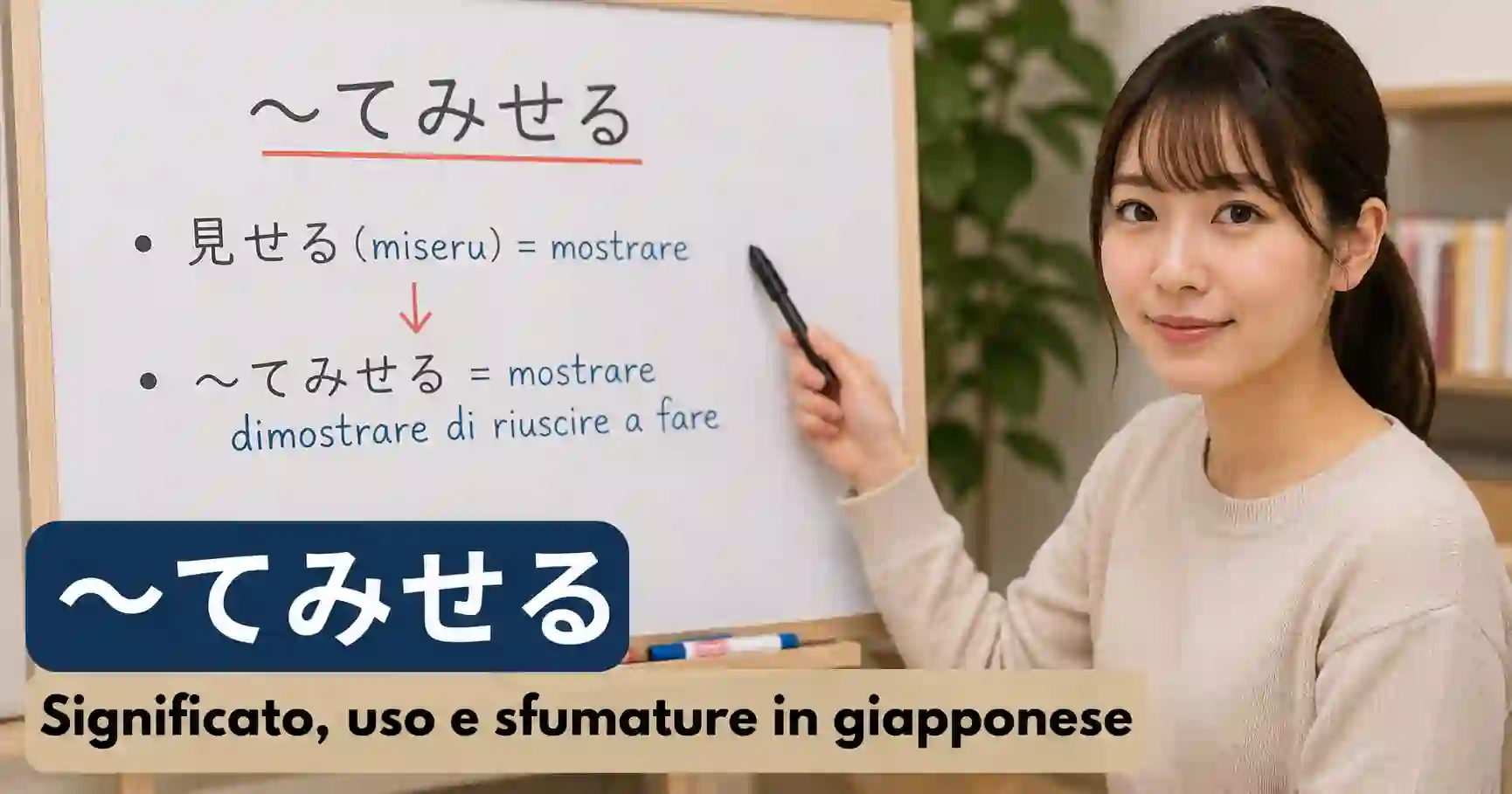
A complete guide to てみせる. Its core meaning, origin from the verb 見せる, grammatical function, differences between literal and idiomatic usage, formation rules, nuances of determination and resolve, detailed examples, and translations.
What does ところだった mean in Japanese? Discover its origin, formation, grammatical rules, nuances, usage examples, and differences from similar expressions such as そうになる.
What does 頂戴 (choudai) mean in Japanese? Learn its original humble meaning of 'receiving', its colloquial use for requests, its grammar, historical development, and the differences between 頂戴, いただく, もらう and ください.
What is the Japanese suffix 的(teki)? Discover the meaning, grammatical function, historical origin, formation rules, and usage register of one of the most productive structures in Japanese.
What does ~そうになる mean in Japanese? Learn how this grammar pattern expresses imminence and near-occurrence, how it is formed, how it differs from ~かける and ~ようになる, and how it is used in real Japanese.
Discover the true meaning of the Japanese suffix ~性 (せい): not just '-ity', but abstract properties, inherent nature, and analyzable categories. A complete explanation of its origin, grammatical function, combination rules, and differences from ~さ, ~み, and ~的.
What does わけではない really mean? Far more than simply 'it’s not that'. A complete analysis of the structure, a grammatical dissection of わけ・では・ない, the concept of partial negation, and its real-world usage in Japanese. An advanced explanation with examples and comparisons.
How do you say ‘something’, ‘someone’, and ‘some people’ in Japanese? Discover the meaning of 何か, 誰か, and 何人か, and how the particle か creates indefiniteness. A clear and in-depth explanation.
Discover the real meaning of the Japanese suffix ~め: not just degree, but deviation from a standard. An in-depth grammatical analysis with examples and nuanced explanations.
An in-depth analysis of the Japanese marker のか: structure, nuance, and comparisons with か and のだ. Learn how のか expresses doubt, conjecture, and suspended judgment in modern Japanese (JLPT N3–N2).